R&D pilot live · ALDOT I-20/59Request Demo
Real-time AI incident detection across the RTSP cameras agencies already operate. Single-batch GPU inference with YOLO12 + TensorRT, automated 55-second clips, full TMC incident lifecycle, and a self-learning false-positive layer that gets quieter the longer your operators use it. FreeACT ships with the dashboard, the alert pipeline, and the analytics layer in one deployable package.
FreeACT runs a single YOLO12 batch every cycle and routes the results into four independent detection pipelines, each with its own confirmation logic, alert lifecycle, and visual treatment on the dashboard.
IoU-tracked candidates with bottom-center velocity. Confirms after 10s of evidence and 4–6 fresh hits, then waits 15s before triggering, eliminating false alerts from brief legitimate stops.
Confirmed person detections via YOLO. Per-camera adaptive thresholds learn from operator dismissals. Auto-suppressed at night to avoid shadow false positives. Independent alert pipeline.
Non-vehicle objects on the roadway, tires, ladders, mattresses, debris. Reuses the same YOLO inference (zero extra GPU cost) with IoU-tracked evidence accumulation. Night-suppressed.
Triggers when vehicle count crosses 75% of the camera's daily peak, confirmed via a 3-of-5 sliding window so a single noisy cycle never alerts. 10-cycle warmup suppresses startup false positives.
Click through the stages to see exactly what happens between a vehicle stopping on the freeway and a TMC operator getting an alert with video evidence.
First YOLO match. New candidate created.
Seven views, one live state. Vanilla JS over a FastAPI backend with WebSocket fan-out, supports 100+ concurrent viewers per server.
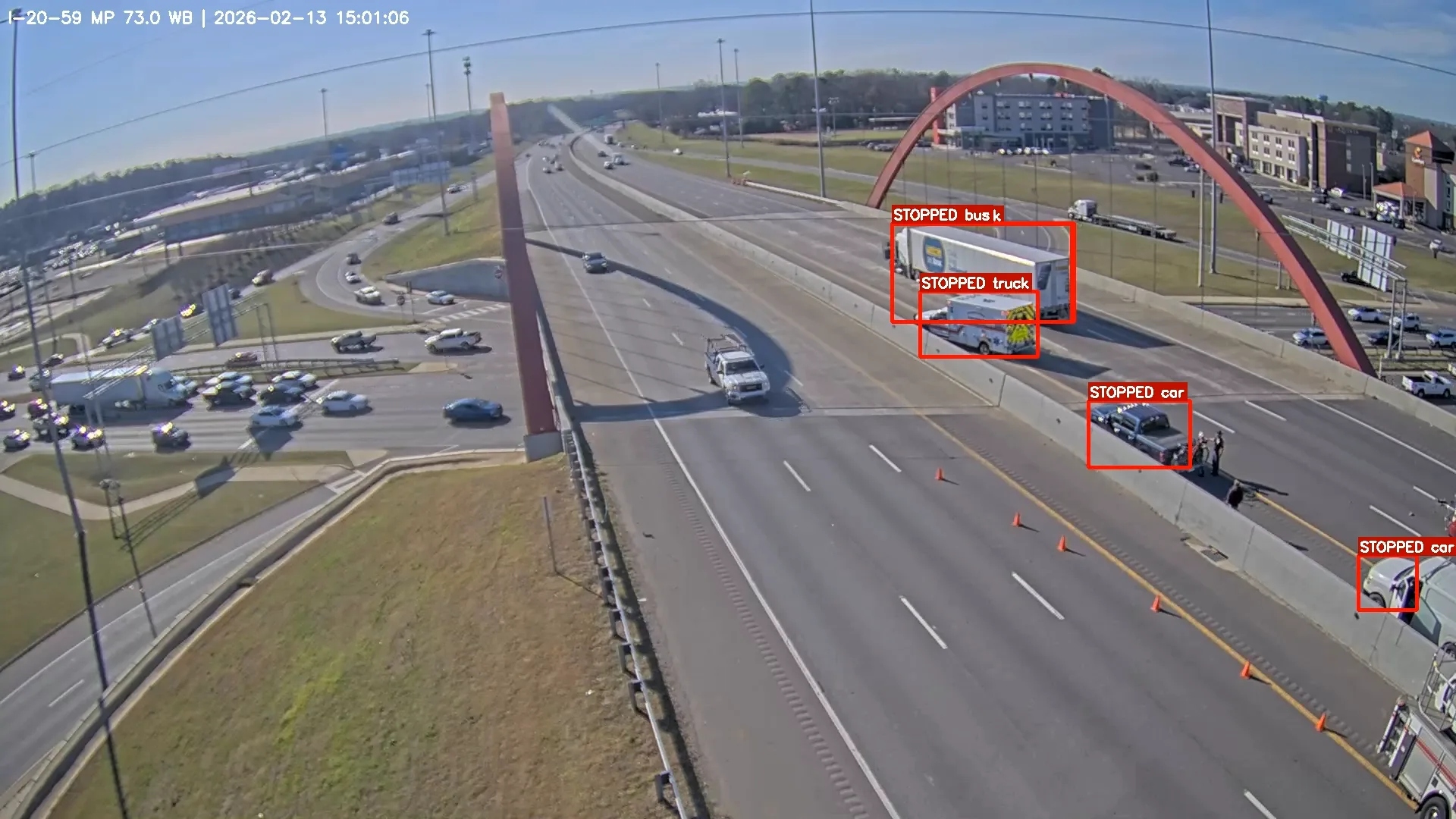
Actual capture from the ALDOT R&D pilot, I-20/59 MP 73.0 WB on 2026-02-13: three vehicles flagged as STOPPED simultaneously. The bounding boxes, labels, and timestamps are exactly what operators see on the live dashboard.
Operators advance through standard TMC stages on every incident. Every action is attributed to a named user and appended to operator_audit.log , so shift handoffs are seamless and after-action reports are honest.
Resources have been called out. Operator advances stage and timestamp persists to incident_management CSV. All actions appended to operator_audit.log with username.
Every dismissal teaches the system. A per-camera evidence multiplier and a permanent spatial suppression zone, both gated so a real vehicle that drives in and stops always bypasses suppression.
When an operator dismisses a false alert, the camera's confirmation threshold steps up by +0.15. Future candidates need more evidence to confirm. The multiplier decays at 0.02/day, full recovery in ~15 days.
Per-camera. Reversible by 'mark as true alert' within 60 minutes.
Labelling a clip as a barrel, sign, or guardrail false positive creates a permanent zone at that bounding box. The zone is only checked at confirmation time, and only if the candidate has never moved. Vehicles that drove in then stopped always bypass suppression.
14-day auto-expiry if no FP recurs. Admins can view and delete zones from the dashboard header.
One initial alert + a milestone schedule that escalates exactly until it stops being useful, then quiets down on its own. SMTP email and webhook payloads (Teams, Slack, Discord) for every fire.
[FreeACT] MEDIUM: Stopped Vehicle, I-20-59 MP 74.1 EB
[FreeACT] [10-MIN UPDATE] Stopped Vehicle, MP 74.1 EB
[FreeACT] [30-MIN UPDATE] Stopped Vehicle, MP 74.1 EB
[FreeACT] [CRITICAL · 60-MIN] Stopped Vehicle, MP 74.1 EB
[FreeACT] [4-HR UPDATE] Stopped Vehicle, MP 74.1 EB
[FreeACT] [8-HR UPDATE] Stopped Vehicle, MP 74.1 EB
[FreeACT] [24-HR FINAL] Stopped Vehicle, MP 74.1 EB
Values measured against the live ALDOT I-20/59 R&D pilot, not aspirational targets.
Architectural detail, dashboard tour, and end-to-end incident walkthrough.
The system is built, tested, and running today on I-20/59 and the University of Alabama campus. We can demo it on your cameras next.